A companion tool for Elite Dangerous commanders
A small always-on-top panel that reads your Player Journal live: mission cards with objectives and timers, a proactive operator that nudges you when you stall, an AI wingman answering over local neural voices, trade and exobiology leads — and a space-opera chronicle written from what you actually did. Everything runs on your machine.
Free hobby project. Two offline voices included. AI features optional.
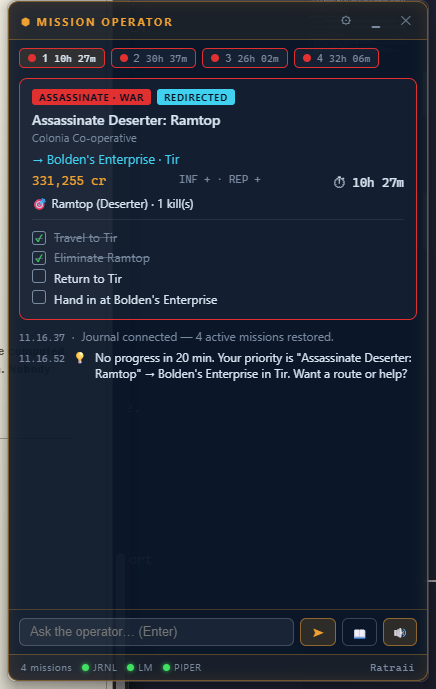
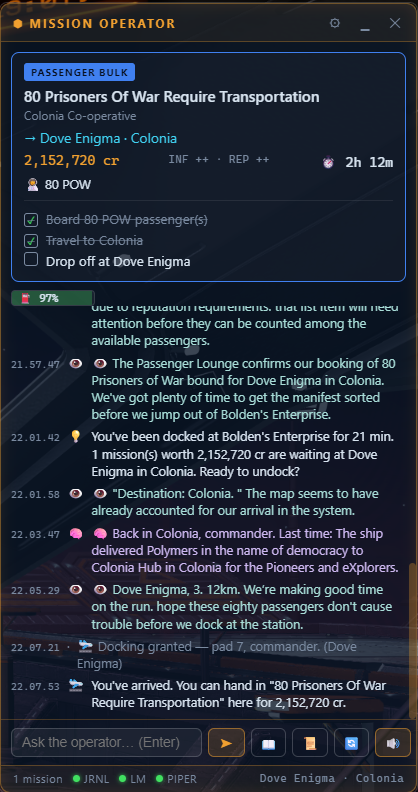
Reads the game's own journal files as you play. Cards show category, destination, reward, kill and cargo counters, gift commodities for VIPs, and a synthesized objective checklist the game never gives you — with live expiry timers.
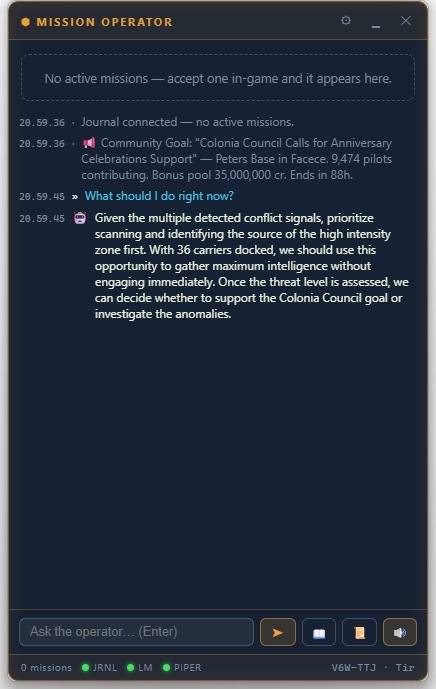
The operator notices when you stall: docked too long with hand-ins waiting, parked in a kill system without engaging, a contract about to expire. It tells you — out loud — and names the actual RES site or Nav Beacon it detected in-system.
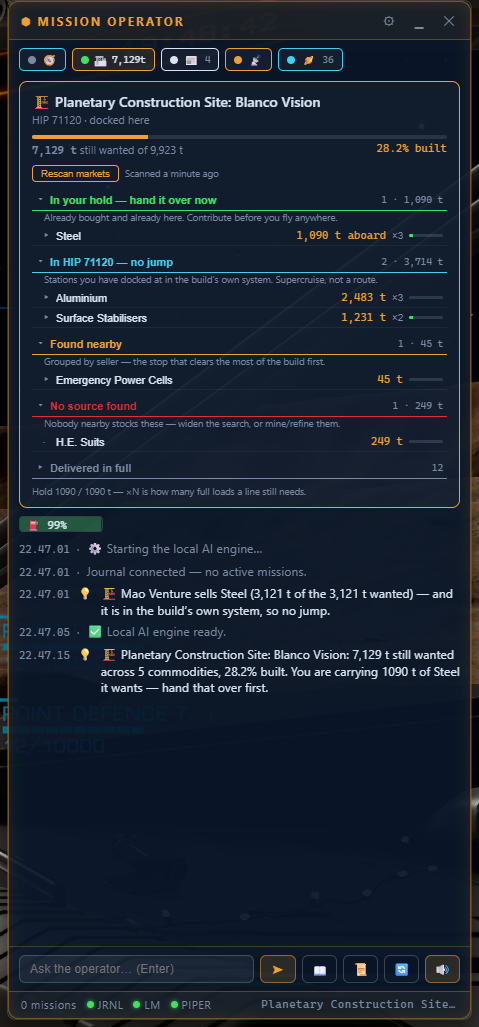
Hook up the free LM Studio and ask anything — "what should I do first?" gets an answer grounded in your real missions, system intel and expiry order. A built-in advisor reads your PC's RAM and GPU and tells you which models actually fit.
Two bundled Piper voices speak briefings, warnings and stories — no cloud, ever. Six more voices are a one-click download away. Text never leaves your machine.
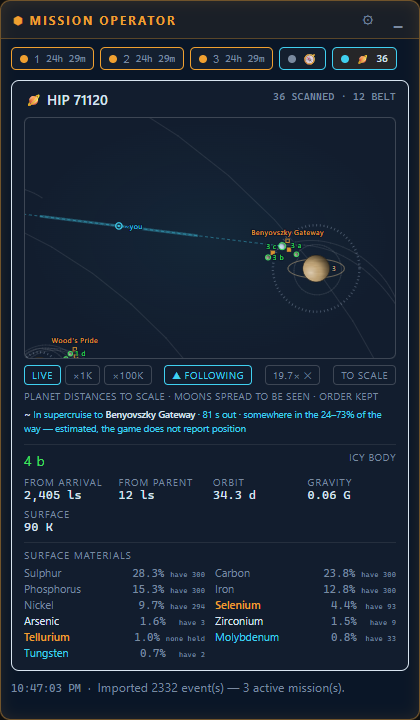
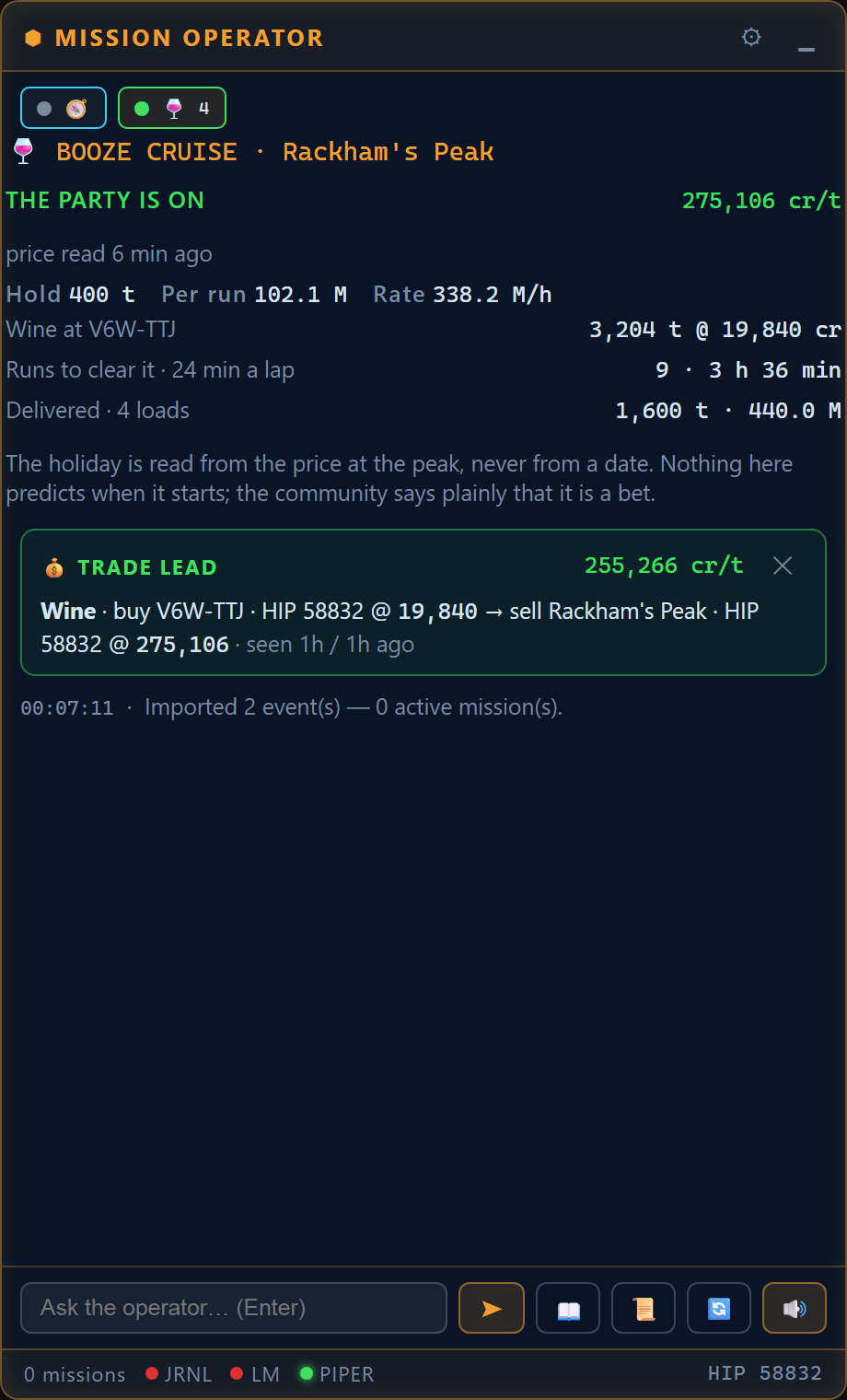
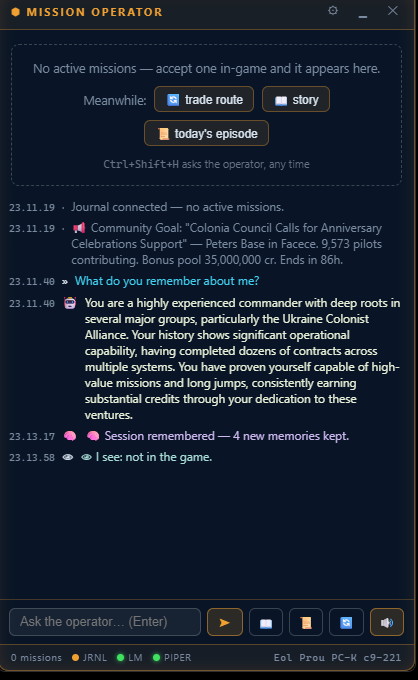
Every commodities market you open is remembered; when a buy-low / sell-high spread clears your threshold, a dismissible trade lead card appears. Same for planets with bio signals you haven't sampled — unclaimed Vista Genomics money, tracked. An opt-in route planner (community data via Spansh) finds profitable multi-hop runs from your current station, sized to your actual cargo hold — and keeps the next waypoint on your clipboard: jump in, and the following system is already copied for a quick Ctrl+V in the galaxy map.
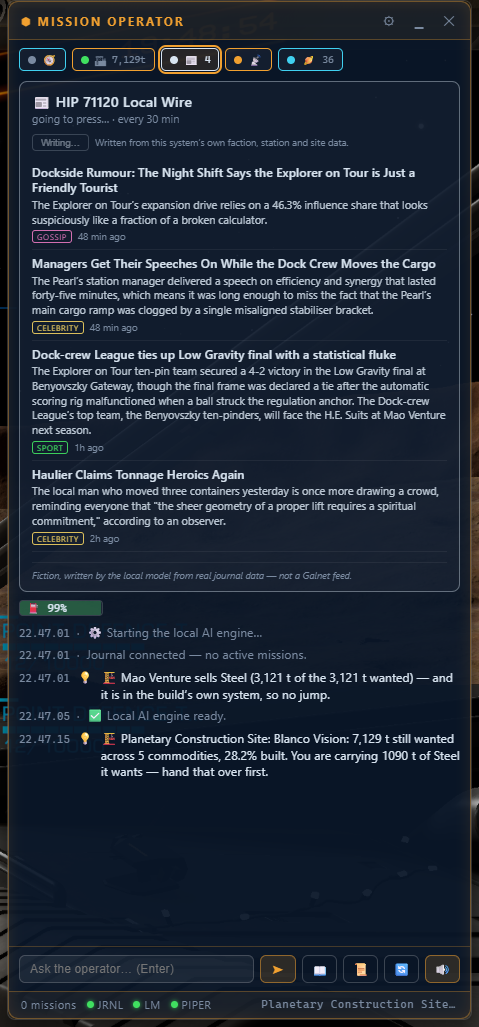
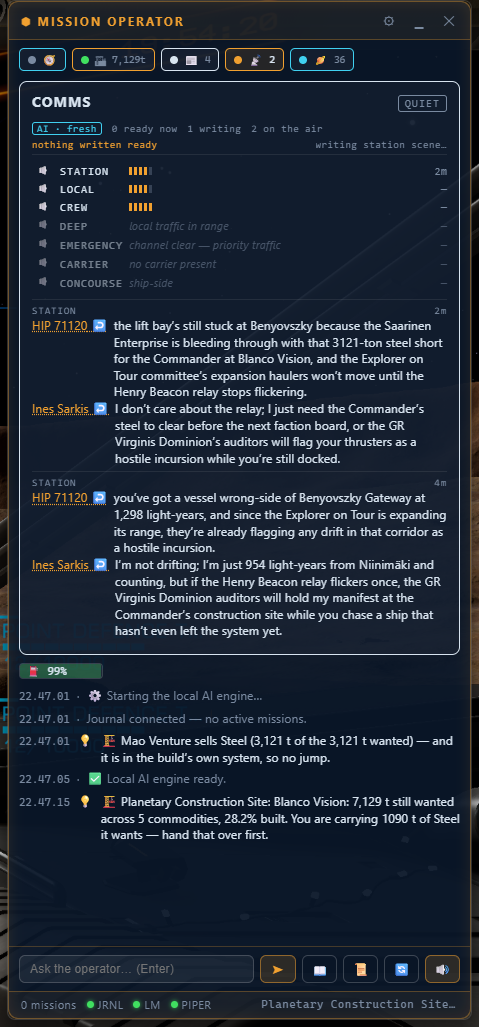
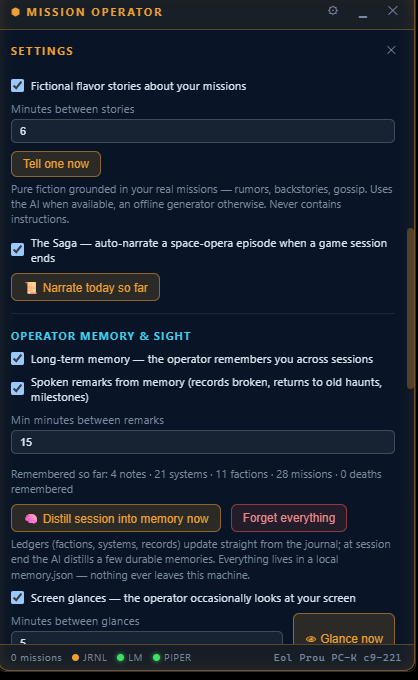
When you log off, the operator narrates your session as a numbered space-opera episode — real events, real credits, real names, with continuity from the previous chapter and a cliffhanger for the next. Plus in-flight scuttlebutt about your passengers and the places on your route.
Click the download button above — you get a single file, ED-Mission-Operator-0.1.0-setup.exe (about 131 MB — it carries the offline voices). Your browser may ask where to save it; Downloads is fine.
Double-click the downloaded file. Windows will very likely show a blue "Windows protected your PC" screen. That's SmartScreen being cautious about a small hobby app that isn't code-signed — not a virus detection.
The installer needs no choices and no administrator password — it installs only for your user account and starts the app when done.
A small dark panel appears and floats above other windows — that's the operator. Drag it by its title bar to wherever suits your cockpit. It reads "Journal connected" at the bottom when it has found your game files (automatic — no setup needed if Elite has ever run on this PC).
In the game: Options → Graphics → Display → Borderless (a true Fullscreen display hides all overlays — this is a Windows rule, not the app's). Your active missions appear on the HUD by themselves; accept a new one at any mission board and the operator will introduce it, out loud.
Everything above works without this. For AI answers and richer stories, install the free LM Studio from lmstudio.ai, then inside LM Studio:
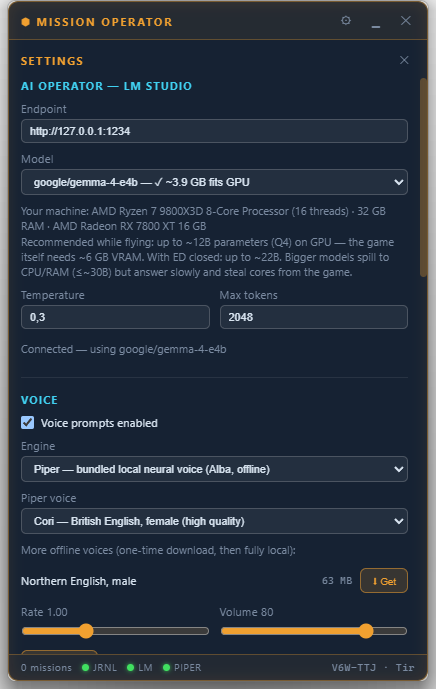
The HUD's LM dot turns green when it finds LM Studio. Unsure what your PC can run? Open the HUD's Settings ⚙ — it reads your RAM and graphics card and marks every model ✓ fits or ⚠ too big.
The operator speaks out of the box (Alba, a Scottish neural voice — fully offline). In Settings ⚙ you can switch to the bundled male voice, download six more with one click, adjust rate and volume, tune how chatty the storytelling is — or mute everything with the 🔊 button.
Windows Settings → Apps → Installed apps → ED Mission Operator → Uninstall. It leaves your game and its files untouched (it never wrote to them in the first place).
| Keys | Action |
|---|---|
| Ctrl Shift M | Show / hide the HUD |
| Ctrl Shift H | Ask the operator "what should I do right now?" |
| Ctrl Shift V | Toggle voice |
| Ctrl Shift J | Cycle through active missions |
| Ctrl Shift K | Collapse to a compact bar |
| Ctrl Shift T | Click-through mode (mouse ignores the HUD) |
No. Missions, voices, leads and stories all work offline. Internet is only touched if you install LM Studio models, download extra voices, or enable the optional Spansh route planner — each on your explicit click, all off by default.
The HUD itself is negligible. AI answers use your GPU for a few seconds when generated — and the built-in advisor deliberately recommends models that leave the game's share of the graphics card alone.
Open, private groups and solo — it only reads what the game writes locally, so it works identically everywhere, including Horizons and Odyssey, on foot or in a ring.
The HUD degrades politely: no LM Studio → deterministic guidance; no voice → text; no game running → it waits. Restart the app and it rebuilds everything from the journal.